

Why Anthropic’s new Claude plugins sparked global selloff in software stocks
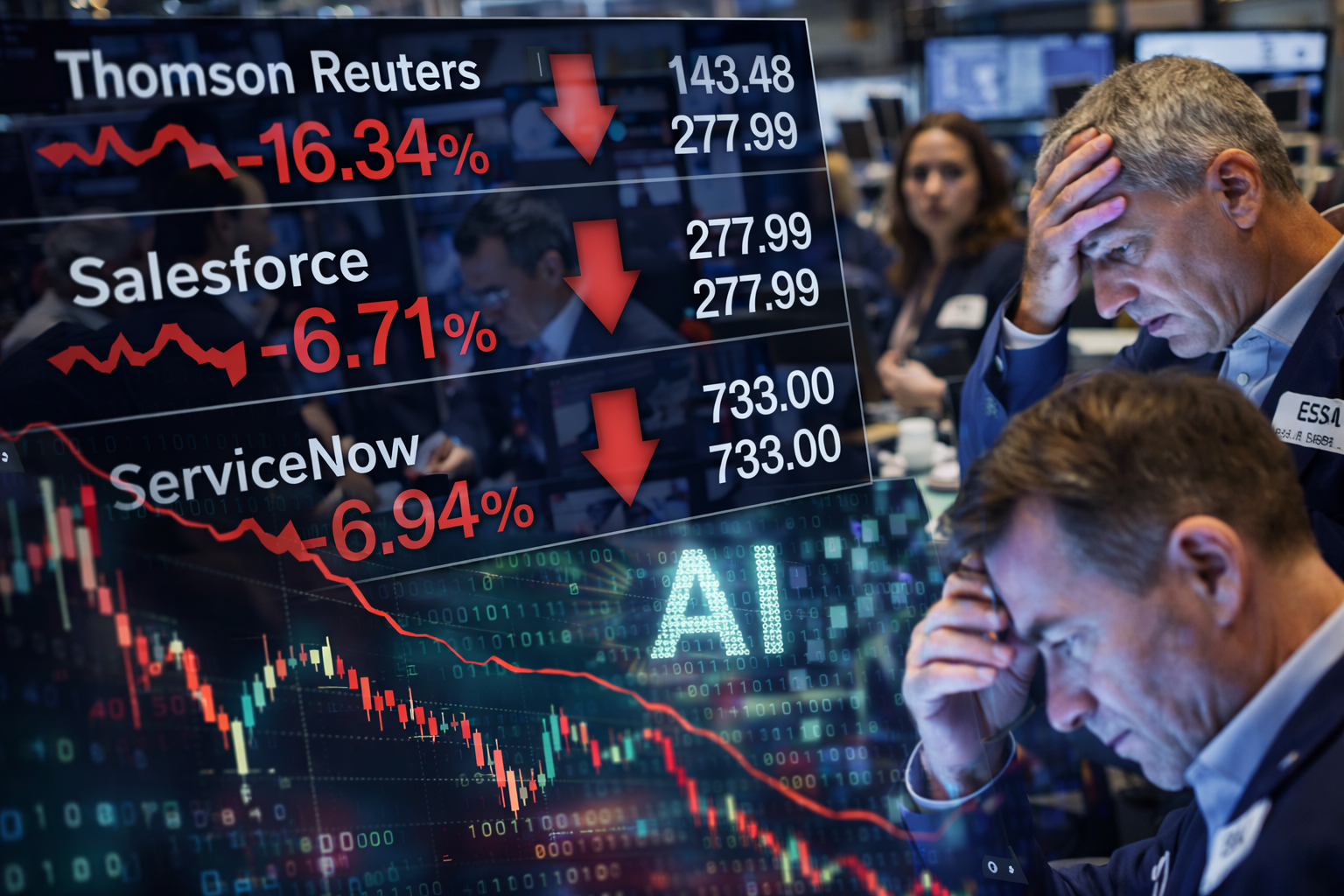
A sharp selloff in global software stocks deepened on Wednesday for a second day as investors grappled with the unsettling possibility that artificial intelligence could erode, rather than enhance, the business models of technology and data companies.
The anxiety first came to the fore on Tuesday after investors woke up to the launch of new automation tools by AI startup Anthropic, which highlighted how rapidly artificial intelligence is moving into areas traditionally dominated by software firms and professional services providers.
On Friday, the company had announced in a blog the launch of plugins that could customize Claude and automate tasks across legal, sales, marketing and data analysis.
The development triggered a wave of selling in legal software and publishing firms like the London Stock Exchange Group (slid by 13%), and Thomson Reuters plunging 16% among others.
Software stocks like ServiceNow and Salesforce were hit, too.
On Wednesday, software stocks declined across Asia, from India to Japan, extending losses from Wall Street overnight as investors grew increasingly worried that artificial intelligence could disrupt traditional business models.
“We call it the ‘SaaSpocalypse,’ an apocalypse for software-as-a-service stocks,” said Jeffrey Favuzza, who works on the equity trading desk at Jefferies, in a Bloomberg report.
“Trading is very much ‘get me out’ style selling.”
Data and legal software firms lead declines
The selloff was most pronounced among companies exposed to legal, data and analytics services, sectors now seen as particularly vulnerable to automation by AI tools.
During Tuesday’s session, the London Stock Exchange Group plunged about 13%, while Thomson Reuters dropped roughly 16%.
Legal technology company CS Disco slid around 12%, and LegalZoom tumbled close to 20%.
Other professional services firms also suffered heavy losses. FactSet Research fell about 10.5%, Morningstar declined around 9%, and LegalZoom again featured among the biggest losers.
The pressure quickly spread to enterprise software giants. ServiceNow and Salesforce both dropped nearly 7%, underscoring the breadth of investor concern.
Private credit stocks also retreated, with firms such as Blue Owl and TPG declining as fears mounted that prolonged weakness in software valuations could spill over into financial markets.
Software companies now account for a growing share of private credit portfolios.
According to Barclays, software represents about 20% of investments in business development companies, compared with roughly 10% in 2016.
Wall Street selloff wipes out $300 billion
The turmoil in software stocks dragged broader US markets lower on Tuesday. The Nasdaq composite fell about 1.4%, weighed down by technology shares.
The S&P 500 slipped roughly 0.8%, while the Dow Jones Industrial Average, which is less exposed to software, shed around 167 points, or 0.3%.
The scale of the selloff was striking. Around $300 billion in market value was wiped out in a single day in the US market, highlighting how quickly sentiment has turned against the sector.
Even before the latest decline, software and services had been the worst-performing subsector in the S&P Dow Jones indices this year, reflecting mounting unease about long-term growth prospects.
Global contagion: Europe and Asia join the rout
In London, companies perceived as vulnerable to AI disruption were among the biggest fallers on the FTSE 100 on Wednesday.
Sage, the accounting software company, fell about 3.8%, while London Stock Exchange Group declined roughly 3.7%.
Relx, which owns legal information service LexisNexis, dropped around 1.6%.
“The likes of Relx, London Stock Exchange Group, Experian, Sage, Informa and Pearson were smashed as AI provider Anthropic unveiled a new product,” said Dan Coatsworth, head of markets at AJ Bell.
The concern will be that, at the very least, the emergence of tools like the one unveiled by Anthropic will reduce the margins these data-driven companies can achieve and, in a worst-case scenario, disintermediate them entirely.
Indian IT stocks slump sharply
Indian IT exporters were among the hardest hit in Asia, tracking the global selloff in software stocks.
The Indian IT sub-index was on course for its worst day since May 2022, with all 10 constituents in the red.
Persistent Systems slid about 7%, while heavyweight firms Tata Consultancy Services and Infosys fell roughly 7% and 7.4%, respectively.
Wipro declined nearly 4%.
The selloff reflects growing doubts about whether traditional IT services companies can maintain growth as AI tools increasingly automate coding, analytics and business processes.
Why is Anthropic’s new tools sparking disruption fears?
The latest wave of selling was triggered by Anthropic’s launch of new plug-ins for its Claude Cowork system, designed to automate tasks across legal, sales, marketing and data analysis.
Anthropic described the system as a tool capable of delivering professional work with minimal human intervention.
“With Cowork, you set the goal and Claude delivers finished, professional work,” Claude said in its blog post on January 30.
Plugins let you go further: tell Claude how you like work done, which tools and data to pull from, how to handle critical workflows, and what slash commands to expose so your team gets even better and more consistent outcomes.
The plug-ins allow companies to customise AI for specific functions such as financial analysis, legal review, data interpretation and customer support.
By connecting directly to enterprise systems, the tools can perform structured tasks that previously required specialised software or human expertise.
For investors, the implications are profound.
If AI systems can replicate functions traditionally provided by software platforms or professional services firms, the value proposition of many companies could be undermined.
From AI optimism to market anxiety
For much of the past year, artificial intelligence has been viewed as a powerful tailwind for technology stocks, driving soaring valuations and investor enthusiasm.
That narrative is now being questioned.
“If things are advancing as rapidly as we hear from OpenAI and Anthropic, it’s going to be a problem,” said Art Hogan, chief market strategist at B. Riley Wealth Management.
Investors are starting to go after any of the companies that could be disrupted, which is all kinds of software application names.
Jim Reid, head of macro research and thematic strategy at Deutsche Bank, said markets were entering a new phase.
“While the question over the end-winners from AI is unlikely to be answered in 2026, recent months have seen a clear shift in markets from AI euphoria towards more differentiation between companies, and growing concern about its disruption to existing business models,” he said.
Business models under scrutiny
One of the biggest concerns is the vulnerability of subscription-based pricing models.
Many software companies rely on seat-based pricing, where customers pay per user. AI-driven efficiencies could reduce the need for multiple licences, weakening revenue growth.
“We are now in an environment where the sector isn’t just guilty until proven innocent but is now being sentenced before trial,” said Toby Ogg, an analyst at JPMorgan.
Even after recent price drops, investors remain reluctant to buy the dip.
“Earnings beats alone no longer reassure investors,” Ogg said, arguing that companies must prove convincingly that AI will fuel expansion rather than undermine growth prospects.
A turning point for the software sector
The latest selloff suggests that investors are no longer willing to assume that technological progress will automatically translate into higher profits.
Instead, they are demanding clear evidence that AI will strengthen, rather than erode, the foundations of the software industry.
For some companies, AI could unlock new revenue streams and productivity gains. For others, it may threaten core business models built over decades.
“We’re looking at a lot of software names that are seen as companies that may well be disrupted when we start to see the advancement of artificial intelligence,” Hogan said.
We’re seeing a lot of software companies across the spectrum get hit.
The turbulence in global markets over the past two days signals a deeper shift in how investors view the technology sector.
The era of unquestioned optimism about software stocks appears to be fading, replaced by a more cautious, selective and uncertain assessment of who will ultimately win in the age of artificial intelligence.
The post Why Anthropic’s new Claude plugins sparked global selloff in software stocks appeared first on Invezz