
Why are prediction markets suddenly the hottest product in finance and tech?
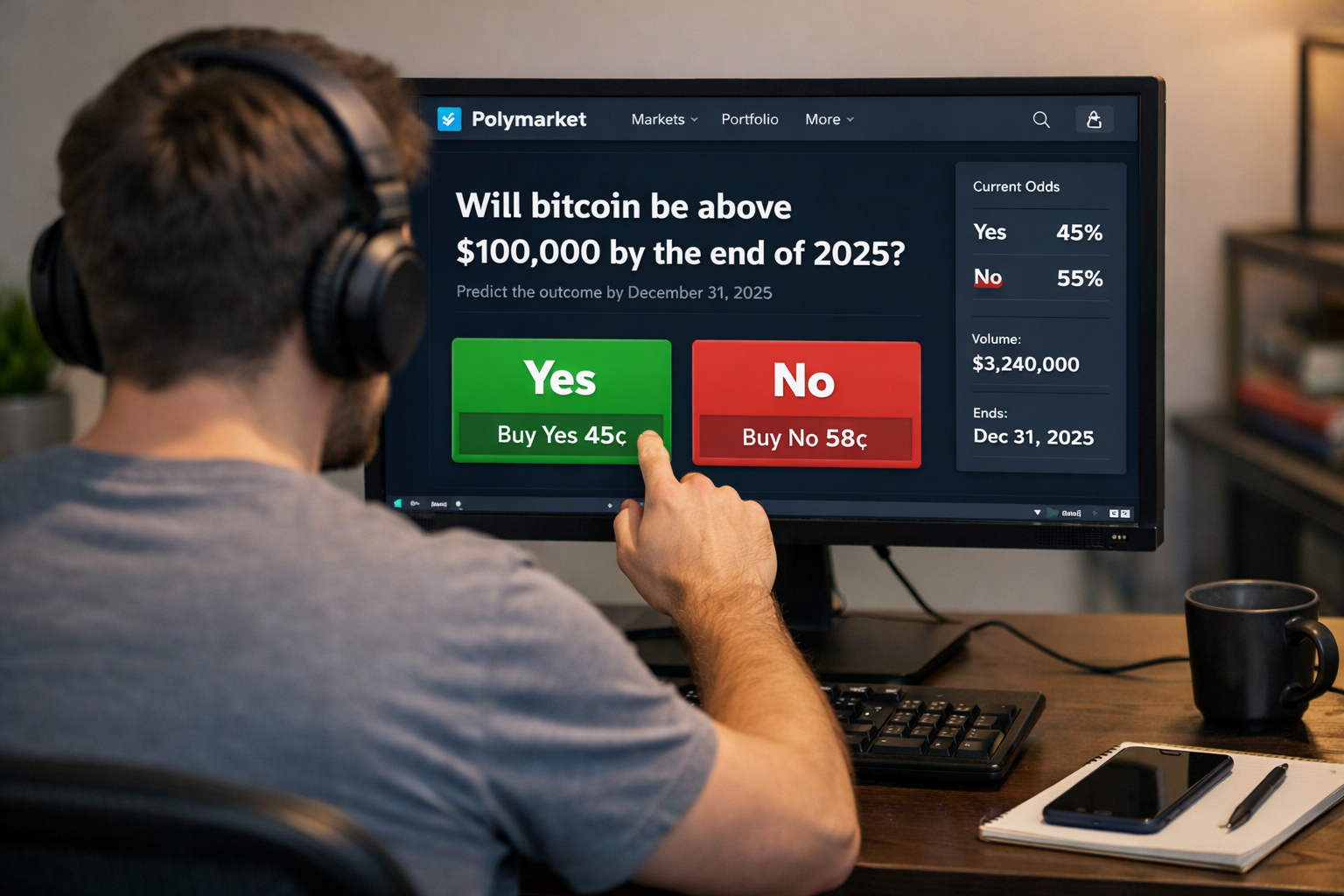
Prediction markets have quietly emerged as the next big frontier in financial innovation, and it seems everyone is suddenly paying attention.
Investors are pouring in, institutions are taking notice, and major platforms are viewing them not as a fad but as a fundamental shift in how belief, risk, and information interact.
And the sudden rise is more than just a passing fad, as the numbers speak for themselves.
Platforms like Polymarket and Kalshi are raking in billions of dollars worth in weekly trading volumes while drawing in multi-billion dollar investments.
Why prediction markets are gaining so much traction is a deeper topic that deserves proper attention.
But before diving into what the hype is all about, one must first understand how it all began and what exactly led to this moment.
The rise of prediction markets and what they are
In the most basic sense, prediction markets are financial platforms that allow anyone to speculate on real-world outcomes, from political elections to economic data, sports, entertainment, or even what celebrity might wear in their next appearance, by simply trading yes or no event contracts.
While this may sound quite similar to gambling, they are fundamentally not the same, as there is no bookmaker or house setting the odds.
Instead, these platforms act as neutral exchanges where users are simply trading directly with one another, and the platform itself has no stake in the final result.
The result? It creates a dynamic pricing mechanism based on crowd sentiment, where users are financially rewarded for being right and penalised for being wrong.
Prediction markets trace their origins back to the 1500s, but their modern resurgence has followed decades of experimentation and regulatory caution.
Interest accelerated in recent years, most notably during the 2024 US election cycle, when these markets drew widespread attention for signalling outcomes more quickly — and often more accurately — than traditional polling and political analysis.
Initially, the industry faced significant opposition on the regulatory front.
Kalshi, one of the earliest regulated players in the United States, ran into legal challenges, as regulators viewed its political betting proposals as illegal “gaming” under the Commodity Exchange Act.
That sidelined much of the sector and left many platforms operating in a legal grey area.
Things, however, took a turn for the better after Kalshi won its lawsuit against the CFTC in October 2024, and the court ruled that election contracts were not gambling but legitimate financial derivatives.
Suddenly, the floodgates were open. Just weeks before the election, Kalshi launched its regulated election markets in all 50 states, and other platforms like Polymarket, which had already built a strong user base while operating offshore, saw their trading volumes explode.
During the election cycle, a clear divergence emerged between traditional opinion polls and prediction market probabilities.
While many polls suggested a tight and uncertain race between Donald Trump and Kamala Harris, platforms such as Polymarket consistently assigned a higher likelihood to a Trump victory, often placing the odds around 60% even as pollsters described the contest as too close to call.
The election outcome reinforced the perception among the public, investors and media that prediction markets had provided a more accurate signal than conventional polling, elevating their profile and credibility.
The episode became a pivotal moment for the sector, accelerating interest and visibility.
In the aftermath, a broad range of major players moved to establish a presence in the space, including firms from traditional finance such as Intercontinental Exchange and CME Group, retail trading platforms like Robinhood and Coinbase, sports betting companies including DraftKings, media organisations such as CNN, and technology groups including Google.
Why does everyone want a prediction market of their own?
From a business perspective, prediction markets offer a major opportunity for several reasons:
The exchange fee goldmine
One of the most compelling drivers for financial firms, fintech platforms, and even traditional exchanges is that platforms offering prediction markets can directly benefit from massive volumes of trading activity.
Event contracts, by nature, have an extremely low barrier to entry.
The structure of these markets, which operate continuously and process high trading volumes, allows even small transaction fees to accumulate into a steady, low-risk revenue stream.
Because pricing adjusts in real time to virtually any real-world development, platforms can generate frequent income from constant activity.
Platforms like Polymarket and Kalshi have already proven this model at scale.
For instance, by late 2025, Polymarket was seeing roughly $2 billion in weekly trading volume.
The proprietary data monopoly
Beyond trading fees, ownership of a prediction market offers access to a continuous flow of real-time sentiment data.
In an environment shaped by advanced technology and machine learning, such data is increasingly viewed as a valuable asset that can be monetised through additional products and services.
For example, if an exchange operator such as Intercontinental Exchange were to own a platform where participants trade on the likelihood of a Suez Canal disruption, it would effectively control a real-time signal of global expectations.
That signal would update continuously and reflect the views of traders committing capital, providing a market-based early indicator of potential events.
These implied probability signals can then be cleaned, packaged, and sold to hedge funds, insurance companies, and supply chain managers for potentially millions of dollars through API subscriptions.
What starts as public opinion ends up as a proprietary feed of real-time forecasting data, giving clients a competitive edge in markets that move faster than traditional news or analyst research.
Drastic reduction in customer acquisition costs
Prediction markets can act as the ultimate engagement loop due to their ability to tie directly into real-time events.
For a platform like Robinhood, this format serves as a strong retention tool during times of low activity in traditional markets.
At the same time, there is a universal appeal; placing an opinion on an outcome feels more approachable and doesn’t require great technical skill.
The gamified nature draws in more users based on instinct or common sense.
Prediction markets also solve the marketing problem better than any other financial product.
In business terms, this is known as organic virality, and it makes them inherently more scalable than older models.
On one hand, a traditional brokerage would have to spend heavily on ads, but in this case, event contracts are parasitic to the news cycle; they thrive on whatever people are already talking about. Basically, the world is the marketing department.
From a business retention perspective, the most profitable products are those that keep users coming back multiple times a day, and because event contracts track real-time controversy, users check the app constantly to see how the “odds” have shifted.
Add to that the fact that people love to be right and love to prove it, which boosts social shareability and creates a self-reinforcing loop.
As mentioned before, these markets also come with a much lower barrier to entry, allowing platforms to reach a massive new demographic of everyday users at a fraction of the typical acquisition cost.
What lies ahead?
Prediction markets have already come a long way from obscure academic tools to high-traffic platforms influencing headlines and institutional strategies.
But this still feels like the early innings.
For decades, financial markets have revolved around pricing what we own. Prediction markets flip that model.
They price what we believe in. What will happen? Who might win? What decisions are likely? That opens up an entirely new class of tradable information.
Beyond the technicalities, prediction markets are also a philosophical evolution, turning human conviction into measurable, liquid signals.
And that might prove to be one of the most important breakthroughs in how we forecast and navigate an increasingly uncertain world.
The post Why are prediction markets suddenly the hottest product in finance and tech? appeared first on Invezz